
If you are dealing with white crusty buildup on your faucets or dry, itchy skin after a shower, you’ve likely looked into water treatment. However, the search for a solution often leads to a confusing debate: Soft water conditioners vs. water softeners.
While the terms are often used interchangeably by marketers, they represent two completely different technologies. This guide will break down the differences in effectiveness, cost, and maintenance to help you decide which is right for your home.
The experts at WaterSmart can help you figure out what’s best for your household. Contact us today.
Key Takeaways
Water Softeners: The only systems that physically remove hardness minerals. Best for a luxury feel and preventing soap scum.
Water Conditioners: These are descalers. They keep minerals in the water but prevent them from sticking to pipes. Best for low-maintenance "green" homes.
Maintenance: Softeners require salt refills; Conditioners are generally "set it and forget it" for 1–3 years at a time.
1. Soft Water Conditioners vs Traditional Softeners: Defining the Systems
Traditional Water Softener (Ion Exchange)
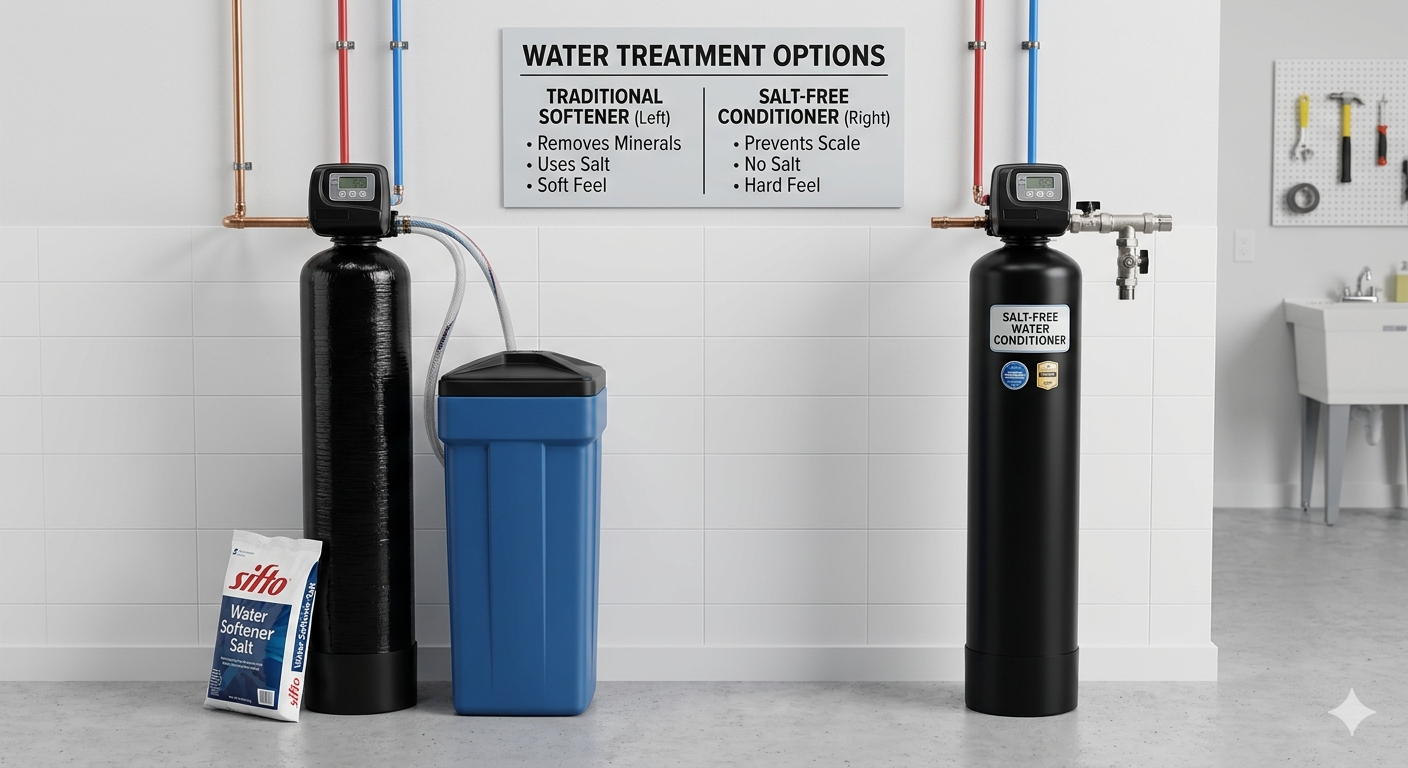
A water softener is a chemical, physical-exchange plant for your home. Inside the tank are millions of microscopic resin beads charged with sodium ions.
As hard water (rich in Calcium and Magnesium) flows through, the beads act like a magnet, grabbing the hardness minerals and releasing a tiny amount of sodium in their place.
When the beads are "full" of minerals, the system enters a regeneration cycle, flushing the minerals away with a brine solution and recharging the beads.
Soft Water Conditioner (Physical Water Treatment)
Conditioners do not use chemicals or salt to remove minerals. Instead, they use Template Assisted Crystallization (TAC).
As water passes through the conditioning media, the hardness minerals are converted into microscopic seed crystals. These crystals remain suspended in the water but lose their ability to stick to surfaces. They simply flow through your plumbing and down the drain without creating scale.
2. Side-by-Side Comparison
| Feature | Water Softener | Water Conditioner |
|---|---|---|
| Mineral Removal | 100% Removal | 0% Removal (Neutralizes) |
| Scale Prevention | Excellent (Removes cause) | Good (Prevents sticking) |
| Salt Usage | Required (Monthly) | None |
| Maintenance | Moderate (Adding salt) | Low (Annual check) |
| Water Feel | Slippery / "Clean" | Standard hard water feel |
| Soap Lather | High (Uses 50% less) | Standard (No change) |
| Eco-Impact | Salt discharge (Brine) | Eco-friendly (No waste) |
3. Detailed Analysis: Effectiveness & Maintenance
Plumbing & Appliance Protection
The "best" system often depends on what you are trying to save.
For the Water Heater: Both systems are excellent. Scale is the #1 killer of water heaters, and both technologies prevent that rock buildup on heating elements, maintaining your energy efficiency.
For Surfaces and Fixtures: This is where the softener wins. Because a softener removes the minerals, you won't see white spots on your glass shower doors or film on your silverware. A conditioner prevents scale inside the pipes, but because the minerals are still present, you will still see spotting on surfaces where water is allowed to air-dry.
Maintenance and Longevity
Softener: Requires a hands-on approach. You must monitor salt levels and physically lift and pour 40lb bags of salt into the brine tank every few weeks.
Conditioner: Truly a "set it and forget it" system. There are no salt bags to buy, no wastewater produced, and no electricity required. Most media only needs to be replaced every 3 to 5 years.
4. Myths and Misconceptions
Myth: "Salt-free softeners" are just as good for laundry.
The Reality: Not quite. To get truly bright whites and use less detergent, the minerals must be removed. A conditioner helps your washing machine last longer, but it won't help your detergent suds up better or prevent "dingy" whites.
Myth: Water softeners make your water "salty."
The Reality: The amount of sodium added to a gallon of soft water is roughly equivalent to the sodium in a single slice of bread. It is not "salty" to the taste, though many homeowners choose to pair their softener with a Reverse Osmosis system for purified drinking water.
Myth: Removing minerals from water makes it "less healthy" to drink.
The Reality: While calcium and magnesium are essential nutrients, the amounts found in hard tap water are statistically insignificant compared to your diet. You would have to drink gallons of hard water to get the same amount of calcium found in a single glass of milk. Water treatment is about protecting your home and skin; you should look to food, not your pipes, for your daily mineral intake.
5. Decision Guide: Which Should You Choose?
Choose a Traditional Water Softener if:
You are tired of scrubbing soap scum and "ring around the tub."
You have eczema or dry skin issues that are aggravated by hard water minerals.
You want your towels and clothes to feel soft, not "crunchy."
You want the absolute best protection for every water-using appliance in the house.
Choose a Water Conditioner if:
You live in a "Salt-Restricted" zone where traditional softeners are banned.
You don't want the physical hassle of carrying heavy salt bags.
You are primarily focused on protecting the lifespan of your pipes and tankless water heater.
You prefer the taste of mineral-rich water but want to avoid the internal scale.

Determine the Best Solution with WaterSmart
Choosing between a conditioner and a softener isn't just about preference—it's about your home's specific water chemistry and your local environment.
At WaterSmart, we don't believe in one-size-fits-all. We provide professional water testing and honest, expert advice to ensure you get the system that fits your lifestyle and your budget.
Stop guessing and start enjoying better water. Contact WaterSmart today for a free consultation and water test!
“Fantastic service!! Water softener fixed and we are good to go for a few more years. Greg and Scott were fantastic to deal with!”