Home Water Solutions

Soft Water Conditioners vs Traditional Softeners - What’s Best?

If you are dealing with white crusty buildup on your faucets or dry, itchy skin after a shower, you’ve likely looked into water treatment. However, the search for a solution often leads to a confusing debate: Soft water conditioners vs. water softeners.

While the terms are often used interchangeably by marketers, they represent two completely different technologies. This guide will break down the differences in effectiveness, cost, and maintenance to help you decide which is right for your home.

  1. Soft Water Conditioners vs Traditional Softeners: Defining the Systems

  2. Side-by-Side Comparison

  3. Detailed Analysis: Effectiveness & Maintenance

  4. Myths and Misconceptions

  5. Decision Guide: Which Should You Choose?

The experts at WaterSmart can help you figure out what’s best for your household. Contact us today.


Key Takeaways

  • Water Softeners: The only systems that physically remove hardness minerals. Best for a luxury feel and preventing soap scum.

  • Water Conditioners: These are descalers. They keep minerals in the water but prevent them from sticking to pipes. Best for low-maintenance "green" homes.

  • Maintenance: Softeners require salt refills; Conditioners are generally "set it and forget it" for 1–3 years at a time.

1. Soft Water Conditioners vs Traditional Softeners: Defining the Systems

Traditional Water Softener (Ion Exchange)

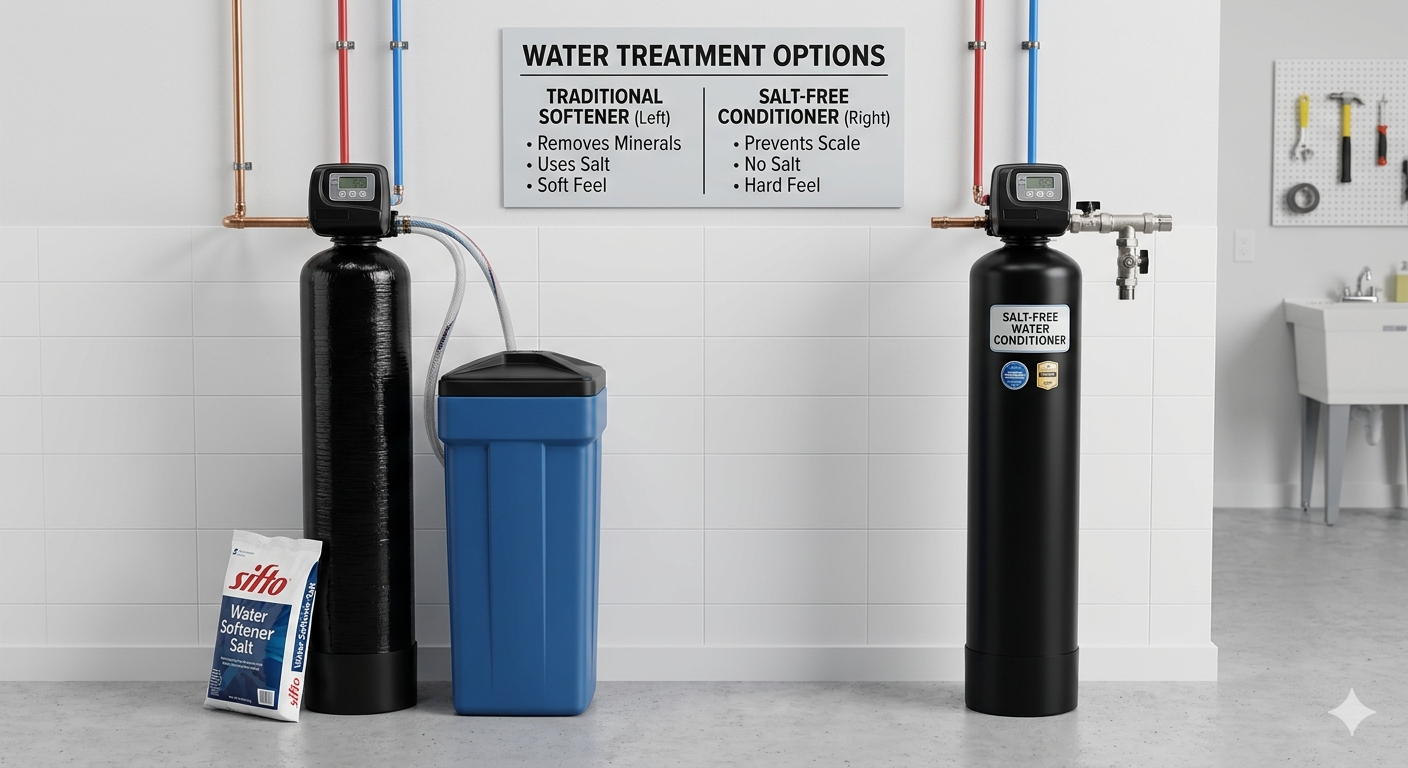
A water softener is a chemical, physical-exchange plant for your home. Inside the tank are millions of microscopic resin beads charged with sodium ions.

As hard water (rich in Calcium and Magnesium) flows through, the beads act like a magnet, grabbing the hardness minerals and releasing a tiny amount of sodium in their place.

When the beads are "full" of minerals, the system enters a regeneration cycle, flushing the minerals away with a brine solution and recharging the beads.

Soft Water Conditioner (Physical Water Treatment)

Conditioners do not use chemicals or salt to remove minerals. Instead, they use Template Assisted Crystallization (TAC).

As water passes through the conditioning media, the hardness minerals are converted into microscopic seed crystals. These crystals remain suspended in the water but lose their ability to stick to surfaces. They simply flow through your plumbing and down the drain without creating scale.


2. Side-by-Side Comparison

Feature Water Softener Water Conditioner
Mineral Removal 100% Removal 0% Removal (Neutralizes)
Scale Prevention Excellent (Removes cause) Good (Prevents sticking)
Salt Usage Required (Monthly) None
Maintenance Moderate (Adding salt) Low (Annual check)
Water Feel Slippery / "Clean" Standard hard water feel
Soap Lather High (Uses 50% less) Standard (No change)
Eco-Impact Salt discharge (Brine) Eco-friendly (No waste)

3. Detailed Analysis: Effectiveness & Maintenance

Plumbing & Appliance Protection

The "best" system often depends on what you are trying to save.

  • For the Water Heater: Both systems are excellent. Scale is the #1 killer of water heaters, and both technologies prevent that rock buildup on heating elements, maintaining your energy efficiency.

  • For Surfaces and Fixtures: This is where the softener wins. Because a softener removes the minerals, you won't see white spots on your glass shower doors or film on your silverware. A conditioner prevents scale inside the pipes, but because the minerals are still present, you will still see spotting on surfaces where water is allowed to air-dry.

Maintenance and Longevity

  • Softener: Requires a hands-on approach. You must monitor salt levels and physically lift and pour 40lb bags of salt into the brine tank every few weeks.

  • Conditioner: Truly a "set it and forget it" system. There are no salt bags to buy, no wastewater produced, and no electricity required. Most media only needs to be replaced every 3 to 5 years.


4. Myths and Misconceptions

Myth: "Salt-free softeners" are just as good for laundry.

  • The Reality: Not quite. To get truly bright whites and use less detergent, the minerals must be removed. A conditioner helps your washing machine last longer, but it won't help your detergent suds up better or prevent "dingy" whites.

Myth: Water softeners make your water "salty."

  • The Reality: The amount of sodium added to a gallon of soft water is roughly equivalent to the sodium in a single slice of bread. It is not "salty" to the taste, though many homeowners choose to pair their softener with a Reverse Osmosis system for purified drinking water.

Myth: Removing minerals from water makes it "less healthy" to drink.

  • The Reality: While calcium and magnesium are essential nutrients, the amounts found in hard tap water are statistically insignificant compared to your diet. You would have to drink gallons of hard water to get the same amount of calcium found in a single glass of milk. Water treatment is about protecting your home and skin; you should look to food, not your pipes, for your daily mineral intake.

5. Decision Guide: Which Should You Choose?

Choose a Traditional Water Softener if:

  • You are tired of scrubbing soap scum and "ring around the tub."

  • You have eczema or dry skin issues that are aggravated by hard water minerals.

  • You want your towels and clothes to feel soft, not "crunchy."

  • You want the absolute best protection for every water-using appliance in the house.

Choose a Water Conditioner if:

  • You live in a "Salt-Restricted" zone where traditional softeners are banned.

  • You don't want the physical hassle of carrying heavy salt bags.

  • You are primarily focused on protecting the lifespan of your pipes and tankless water heater.

  • You prefer the taste of mineral-rich water but want to avoid the internal scale.


Determine the Best Solution with WaterSmart

Choosing between a conditioner and a softener isn't just about preference—it's about your home's specific water chemistry and your local environment.

At WaterSmart, we don't believe in one-size-fits-all. We provide professional water testing and honest, expert advice to ensure you get the system that fits your lifestyle and your budget.

Stop guessing and start enjoying better water. Contact WaterSmart today for a free consultation and water test!


Fantastic service!! Water softener fixed and we are good to go for a few more years. Greg and Scott were fantastic to deal with!
— Katie Cassidy
 

Watersmart’s Top Picks for Water Softeners for Entire Houses in Waterloo Region

Living in the Waterloo Region means dealing with some of the hardest water in Canada. Whether you are in Kitchener, Waterloo, Cambridge, or the surrounding townships, the "rock" in your water isn't just an annoyance—it’s a constant tax on your plumbing, appliances, and skin.

At WaterSmart Systems, we’ve spent decades installing and servicing water softeners across Southern Ontario. We know exactly what it takes to protect a home from the local groundwater profile. If you are looking for a water softener for your entire house in the Waterloo Region, here is everything you need to know to make an informed choice.

  1. Why Waterloo Region Water is Unique

  2. Common Issues Waterloo Homeowners Face

  3. Top 3 Recommended Systems for the Region

  4. Should You Consider Other Brands?

  5. FAQs for Waterloo Homeowners

Don't let hard water damage your home any longer. Positioned right here in Waterloo, WaterSmart Systems is your local partner for all things water. Contact or visit us today!


Key Takeaways

  • Extreme Hardness: Local water contains 17–38 grains of hardness per gallon, among the highest in Canada.

  • System Choice Matters: In this region, a "budget" softener from a big-box store often fails within 5 years due to the heavy mineral load.

  • Local Advantage: Systems with look-ahead technology save significant money on salt and water by adapting to Waterloo’s specific groundwater profiles.

  • Professional Care: Licensed installation ensures your system is calibrated for your specific street's hardness levels, preventing scale and protecting warranties.

1. Why Waterloo Region Water is Unique

Most of our drinking water comes from groundwater wells. As water travels through underground aquifers, it picks up heavy amounts of calcium and magnesium from the local limestone.

While hard water is technically anything over 7 grains per gallon (gpg), Waterloo Region typically sees levels ranging from 17 to 38 gpg.

Municipal vs. Well Water

  • Municipal Users: Even city water in Kitchener or Waterloo is incredibly hard. You also have to contend with chlorine used for disinfection, which can prematurely wear down the resin beads inside cheaper softeners.

  • Well Water Users: If you are on a private well in Wilmot or Woolwich, you may also face issues with iron (orange staining) and sediment, requiring a system with higher clear water iron removal capabilities.

In short, a water softener in any Waterloo Region home is a must.

2. Common Issues Waterloo Homeowners Face

Without a high-efficiency whole-home water softener system, you’ll likely notice:

  1. Scale Build-up: White crust on faucets and showerheads.

  2. Appliance Failure: Dishwashers and water heaters failing years before they should.

  3. Dry Skin & Hair: Hard water prevents soap from lathering and leaves a film on your body.

  4. High Energy Bills: Your water heater has to work twice as hard to heat through layers of scale.

For a more detailed breakdown, read Plumbing in Kitchener: Dealing with Hard Water.

2. Top 3 Recommended Systems for Waterloo Region

We’ve selected these models based on their reliability in handling high grain counts and their salt efficiency.

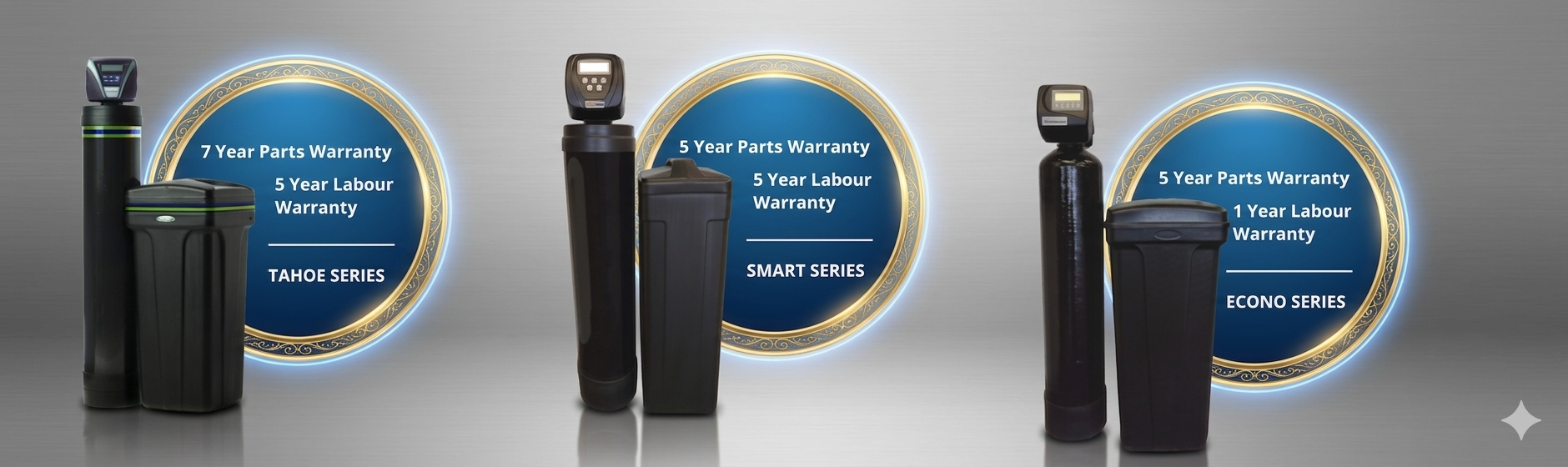
1. The Smart Series by WaterSmart

This is our "gold standard" for the local area. It features a "look ahead" computer that tracks your water usage patterns to ensure it only regenerates when absolutely necessary.

  • Best For: Active families in Kitchener/Waterloo with high water demand.

  • Key Benefit: Maximize salt and water savings while ensuring you never run out of soft water.

2. The Tahoe Series

A rugged, heavy-duty workhorse designed for longevity and high flow rates.

  • Best For: Larger homes with multiple bathrooms or households with higher-than-average water pressure.

  • Key Benefit: High service flow (up to 27 GPM) means no drop in water pressure when the shower and laundry are running simultaneously.

3. The Econo Series

Reliable, simple, and effective. It uses a solid-state programmable computer to regenerate on demand.

  • Best For: Budget-conscious homeowners or smaller households (1-3 people).

  • Key Benefit: Affordable entry point into high-quality soft water without sacrificing local durability.

4. Should You Consider Other Brands?

Many homeowners ask about major brands like Fleck, GE, or Whirlpool. While these are reputable names globally, they often require specific considerations for the Waterloo Region:

  • Fleck Valves: We often service Fleck systems because they are modular and reliable. However, they must be paired with high-quality 10% cross-linked resin to survive the high chlorine and mineral levels found in Southern Ontario.

  • Big-Box Brands (GE/Whirlpool): These are often "cabinet-style" units. While affordable upfront, they frequently struggle with the 30+ grain hardness found in areas like Elmira or North Waterloo, leading to frequent breakdowns.

WaterSmart’s Advantage: We specialize in the repair and service of almost all brands (excluding Kinetico and Culligan due to parts restrictions). This give us a unique perspective: we know which brands break down and why, and we design our house-brand systems to avoid those exact pitfalls.

5. FAQs for Waterloo Homeowners

Q: What should I set my water softener hardness to in Waterloo?

A: Depending on your specific neighborhood, you should usually set it between 25 and 35. We recommend a free water test to get the exact number for your street.

Q: Does a water softener remove chlorine?

A: Standard softeners do not, but we can install a carbon filter or a Reverse Osmosis system in tandem to ensure your drinking water is both soft and chemical-free.

Q: Can I install it myself?

A: While possible, Waterloo plumbing can be tricky. WaterSmart provides free basic installation with every purchase, handled by licensed plumbers who understand local building codes.


Get Hard Water Help Today

Ready to stop the scale and start enjoying truly soft water? Whether you need a brand-new installation for your home or a quick repair on your existing unit, the local experts at WaterSmart Systems are here to help.

3 Ways to Get Started:

  • Schedule a Free Water Test: Find out exactly how many grains of hardness are in your water so we can calibrate your system perfectly.

  • Request a Fast Quote: Tell us about your home size and needs, and we’ll provide a transparent, no-obligation estimate.

  • Visit Our Showroom: See the Smart, Tahoe, and Econo series in person and chat with our friendly staff.

Don't let hard water win. Protect your home and your skin with Waterloo’s most trusted water experts.


From start to finish: easy to call, get necessary answers and arrange service. Service prompt, polite and efficient. No hassles.
— Ingrid Hahn

Are Whole Home Water Purification Systems Worth It? Pros, Costs & Results

For many homeowners, the water coming out of the tap is "good enough." But as concerns over aging infrastructure, PFAS (forever chemicals), and hard water damage grow, many are looking for a more comprehensive solution.

A Whole Home Water Purification System (also known as a Point-of-Entry system) treats every drop of water that enters your home—from the kitchen sink to the shower and the washing machine. But with price tags often reaching into the thousands, is it a luxury or a necessity?

  1. The Pros: Comprehensive Benefits

  2. The Financial Breakdown: Costs & Savings

  3. Real-World Performance Results

  4. Whole-Home vs. Point-of-Use (POU)

  5. Is It Worth It? The Verdict

  6. Guidance: Testing & Recommendations

We’ve got over 30 years of experience with whole-home water purification systems. Contact us to discuss your options today.


Key Takeaways

  • Comprehensive Protection: Unlike pitchers or under-sink filters, whole-home systems treat water at the "Point of Entry" (POE), protecting every faucet, shower, and appliance.

  • Appliance Longevity: By removing minerals and chlorine, these systems can extend the life of your water heater, dishwasher, and washing machine by years.

  • Upfront vs. Long-term: Expect to pay between $1,500 and $5,000 for installation, but look for a "break-even" point through reduced bottled water costs and lower appliance repair bills.

  • Targeted Solutions: Success depends on matching the system to your specific water profile (e.g., UV for bacteria, Carbon for chemicals, or Softeners for minerals).

1. The Pros: Comprehensive Benefits

Total Water Safety and Peace of Mind

While municipal plants treat water to meet federal standards, contaminants like lead, PFAS ("forever chemicals"), and microplastics can enter the supply through aging infrastructure. A whole-home system acts as a final gatekeeper, ensuring your family isn't just drinking clean water, but also bathing in it.

Protection for Your Appliances

Hard water is a silent killer for home machinery. Calcium and magnesium buildup (scale) clogs pipes and forces water heaters to work harder, increasing energy bills. A system with a softening component prevents this scale, preserving your real estate investment.

Healthier Skin and Hair

Chlorine is excellent for killing bacteria in city pipes, but it's harsh on humans. It strips natural oils, leading to dry skin and brittle hair. Homeowners often report significant relief from eczema and skin irritation after removing chlorine from their shower water.

Better Taste and Smell

By removing sulfur (the "rotten egg" smell) and chlorine (the "pool" taste), these systems provide bottled-quality water for everything from your morning coffee to the water you use to boil pasta.

2. The Financial Breakdown: Costs & Savings

To understand the true value of a system, it is essential to look beyond the initial price tag and consider the long-term operational savings and appliance protection.

Expense Type Estimated Cost (2026) Key Notes
Initial System $1,500 – $4,500 Varies by filtration stages and brand technology.
Professional Installation $500 – $1,500 Requires a licensed plumber for main line integration.
Annual Maintenance $150 – $400 Covers sediment filters, carbon media, or salt refills.
Membrane Replacement $50 – $100 Specific to RO systems; replaced every 2–4 years.

The ROI Factor: For a family of four spending $40/month on bottled water, the system saves $480 per year on water alone. When you add the 15-20% extended lifespan for major appliances, the system typically pays for itself within 5 to 7 years.


3. Real-World Performance Results

Most high-end whole-home systems utilize a multi-stage process to ensure results:

  1. Sediment Pre-filter: Traps rust, silt, and large debris.

  2. KDF/Carbon Stage: Neutralizes chlorine, pesticides, and VOCs.

  3. Conditioning/Softening: Chemically alters or removes hard minerals.

  4. UV Sterilization (Optional): Uses light to kill 99.9% of bacteria and viruses—essential for well water.

The Result: Testing usually shows a 99% reduction in chlorine and a significant drop in Total Dissolved Solids (TDS).

Homeowners also notice an immediate lack of "spotting" on glassware and softer-feeling laundry.

4. Whole-Home vs. Point-of-Use (POU)

Choosing between a comprehensive whole-home setup and a targeted point-of-use filter depends on whether you need to protect your entire plumbing infrastructure or simply improve the flavour of your drinking water.

Feature Whole-Home (POE) Point-of-Use (POU)
Scope of Coverage Every faucet, shower, toilet, and appliance in the house. Single specific location (e.g., kitchen sink or fridge).
Protection Prevents pipe corrosion and appliance scale buildup. Improves drinking and cooking water quality only.
Maintenance Infrequent (typically once or twice per year). Frequent (filter changes every 2-3 months).
Installation Requires professional plumbing at the main line. Simple DIY setup under the sink or on the tap.
Best For Hard water, well water, and skin/hair health. Renters or those strictly focused on taste/odor.

5. Is It Worth It? The Verdict

A whole-home system is a worthwhile investment if:

  • You own your home: The long-term protection of your plumbing and increased resale value justify the cost.

  • You have Hard Water: If your "grains of hardness" are above 7, a system is nearly essential.

  • You use Well Water: You are your own utility provider; a POE system is your only line of defence against bacteria and runoff.

It may be overkill if you live in a rental or if your city water is already highly rated and your only concern is the taste of your drinking water (in which case, an under-sink RO system is better).

6. Guidance: Testing & Recommendations

  1. Start with a Lab Test: Don’t buy based on a salesperson’s pitch. Use a certified third-party lab to identify exactly what is in your water (PFAS, Lead, Nitrates, etc.).

  2. Check Your Flow Rate: Ensure the system you buy can handle your home’s peak demand (GPM - Gallons Per Minute) so you don’t lose pressure during showers.

  3. Choose Your "Stack":

    • City Water: Focus on Carbon + Sediment + (Optional) Softener.

    • Well Water: Focus on UV + Iron Filter + Sediment.

By combining professional data with a clear understanding of your household's daily needs, you can transition from simply managing your water quality to mastering it, ensuring a healthier and more efficient home for years to come.

You can also take our plumbing and water systems assessment to help diagnose issues you are experiencing at home to figure out your next steps.


Interested in Whole Home Water Purification Systems?

Stop wondering what’s in your tap and start enjoying the peace of mind that comes with medical-grade water.

Whether you’re looking to protect your high-end appliances or finally solve persistent skin irritation, the right system is an investment that pays dividends in health and home value every single day.

At WaterSmart, we proudly provide the best Canadian-made water softeners along with professional installations.

Our factory-trained technicians can set up your system quickly and efficiently—and installation is always free when you purchase a new water softener from us.

With local expertise and decades of experience, we’ll ensure you get the solution that fits your water test results, household needs, and long-term goals.

From consultation to installation, we make it easy to enjoy the benefits of clean, reliable water in your Waterloo home.

Contact us today to get started.


We had our water softener replaced by Matt and he was great, friendly and efficient. Greg on the phone was also incredibly kind and willing to walk us through diagnosing the issue. Would recommend to everyone looking to fix or replace their water softener.
— Steven Armstrong
 

The Ultimate Guide to Water Efficiency for Ontario Homeowners

In Ontario, water conservation isn't just a responsible environmental choice—it's a smart financial decision. By adopting water-efficient habits and upgrading your home, you can significantly lower your utility bills and help protect our precious freshwater resources for future generations. Residential water use accounts for nearly 60% of municipal water consumption, meaning your actions make a big difference!

  1. Optimize Your Water Softener for Maximum Savings

  2. The Essential Leak Detection and Repair Program

  3. Investing in Smart Appliances and Fixtures

  4. Outdoor Water Conservation and Ontario Regulations

  5. Ontario Rebate and Incentive Programs

  6. Frequently Asked Questions (FAQ)

WaterSmart Systems has been serving the Waterloo Region for over 30 years, and the focus is always on clean, safe, great-tasting water for your home backed by exceptional service.

Contact us today for all your home water solutions.


Key Takeaways

  • Fix Leaks First: The fastest way to cut your bill is by checking and repairing leaks, especially in toilets (the largest source of indoor waste).

  • Go DIR: If you have a water softener, switch from an old-time-based model to a Demand-Initiated Regeneration (DIR) system to save thousands of litres of water and hundreds of kgs of salt annually.

  • Soften Hot Water Only: Modify your plumbing to only soften the hot water line for significant water and salt savings. This may qualify for a local rebate.

  • Look for WaterSense: Replace old fixtures with WaterSense-labelled toilets and showerheads for guaranteed efficiency.

  • Know Your By-laws: Adhere to local Odd/Even day watering by-laws and time restrictions during summer months to avoid fines and conserve water.

  • Check Local Rebates: Investigate your local municipality (e.g., Guelph, Region of Waterloo) for specific rebates on toilet replacements, rain barrels, or plumbing modifications.

1. Optimize Your Water Softener for Maximum Savings

Many parts of Ontario have hard water, making a softener a necessity.

However, an inefficient softener wastes thousands of litres of water and hundreds of kilograms of salt annually.

1. Choose a High-Efficiency Model

The biggest factor in water and salt waste is the type of softener you own.

  • Actionable Tip: If you have an older, time-initiated softener (it regenerates on a set schedule regardless of use), consider replacing it.

  • WaterSmart Solution: Look for a Demand-Initiated Regeneration (DIR) model, like the WaterSmart Smart Series or Econo Series. These systems use sensors to only regenerate when the resin tank is truly depleted, saving both water and salt.

2. Fine-Tune Your Softener Settings

Correct settings are essential for efficiency, especially concerning the salt dosage.

Setting Action for Efficiency Benefit
Water Hardness Set to your actual local water hardness (Grains per Gallon, or GPG). Prevents over-regeneration and excess salt use.
Regeneration Type Use DIR (Demand-Initiated Regeneration). Only regenerates when necessary, minimizing water waste.
Salt Dosage Consult your manual or a professional to find the lowest effective salt dose. Lower salt dosages achieve higher salt efficiency (less salt per grain removed).

3. Consider Hot Water-Only Softening

A common and highly effective strategy to save both salt and water.

  • Strategy: Reroute your cold water line so that it bypasses the water softener. This leaves cold water for drinking, cooking, toilets, and outside taps unsoftened, significantly reducing the volume of water the softener needs to treat.

  • Potential ROI: Softening only hot water can save a household of three up to 8,800 litres of water and 108 kg of salt per year.

  • WaterSmart Solution: The Region of Waterloo has offered a Water Softener Plumbing Rebate for homeowners who switch from softening both hot and cold water to hot water only. Contact WaterSmart Systems & Plumbing for this specific plumbing service.

2. The Essential Leak Detection and Repair Program

A small, persistent leak can cost you more than you realize. A single dripping faucet can waste over 20 litres of water per day, and a running toilet can waste thousands.

1. The Toilet Dye Test

Toilets are the most common source of hidden leaks.

  • Step 1: Place a few drops of food colouring in the toilet tank (the back reservoir).

  • Step 2: Wait 15 to 20 minutes without flushing.

  • Step 3: If the colour appears in the toilet bowl, you have a leak.

2. Check Your Water Meter

Use your main water meter to check for leaks when no water is being used.

  • Step 1: Turn off all indoor and outdoor water taps and appliances.

  • Step 2: Read the number on your water meter (or check the leak indicator dial).

  • Step 3: Read the meter again after 2 hours. If the reading has changed, you have a leak.

3. Promptly Repair Leaks

  • Actionable Tip: Replace faulty toilet flappers, fix dripping faucets, and check outdoor hose bibs for slow drips.

  • Local Policy Note: Many municipalities, such as the City of Guelph, have a Leak Forgiveness Policy for residential homes. If you have a high water bill due to a leak that you promptly fix, you may be eligible for a credit.

3. Investing in Smart Appliances and Fixtures

Upgrading old appliances is a major step toward water efficiency and often qualifies for rebates.

1. WaterSense-Labelled Fixtures

Look for the WaterSense label, which identifies products that are at least 20% more water-efficient than average.

  • Toilets: Replace older toilets (pre-1994, which can use up to 20 litres per flush) with Ultra Low Flow (ULF) or High-Efficiency Toilets (HET).

    • Rebate Example: The Township of Centre Wellington offers a $75 rebate per eligible replacement toilet (check for current program status, as they are often limited).

  • Showerheads and Faucets: Install low-flow showerheads (using $\le 7.6$ litres per minute) and faucet aerators.

2. Efficient Appliances Checklist

Appliance Efficiency Standard Water-Saving Habit
Washing Machine ENERGY STAR® certified high-efficiency clothes washer. Always run full loads.
Dishwasher ENERGY STAR® certified model. Run only when full and do not rinse dishes beforehand.
Irrigation System Use a weather-based or soil moisture sensor controller. Ensures your lawn is not watered when it's raining or when the soil is already moist.

4. Outdoor Water Conservation and Ontario Regulations

Outdoor water use can more than double your water bill in the summer. Smart watering is crucial.

1. Mandatory Lawn Watering Regulations

Many Ontario regions enforce "Odd/Even Day" watering by-laws during peak summer months (typically May to September).

  • Regulation: Homes with even civic numbers can water outdoors on even calendar days. Homes with odd civic numbers can water outdoors on odd calendar days.

  • Time Restrictions: Watering is typically only permitted during specific hours, like 6 a.m.–9 a.m. and 6 p.m.–9 p.m.

  • Actionable Tip: Use a tuna can to measure rainfall and watering. Your lawn only needs about 2.5 centimetres (1 inch) of water per week, including rain.

2. Water-Wise Gardening

  • Install Rain Barrels: Collect rainwater from downspouts for use in your garden. This water is chlorine-free and perfect for plants.

  • Xeriscaping: Choose native, drought-tolerant plants suited to the Ontario climate, which require minimal supplemental watering.

  • Mulch: Apply a layer of organic mulch around plants and trees to retain soil moisture and reduce evaporation.

5. Ontario Rebate and Incentive Programs

While the federal Canada Greener Homes Grant focused primarily on energy efficiency (insulation, windows, heat pumps), local and provincial programs exist specifically for water efficiency.

Program/Incentive Focus Area Notes & Status
Water Softener Rebates Plumbing Modification (Hot Water Only) Offered by some municipalities (e.g., Region of Waterloo). Check local program details.
Royal Flush Toilet Rebates High-Efficiency Toilet Replacement Offered by some municipalities (e.g., City of Guelph, Township of Centre Wellington). Check local program status and limits.
Rain Barrel/Rain Garden Rebates Outdoor Water Reuse/Runoff Management Offered by various municipalities. Programs often provide discounts or rebates on purchase/installation.
Blue Built Home Certification Comprehensive Water Efficiency A regional program (e.g., Region of Waterloo) that certifies homes built or retrofitted to high water-saving standards.

6. Frequently Asked Questions (FAQ)

Q. How can I save water in Ontario?

A. You can save water in Ontario by:

  1. Fixing leaks promptly, especially in toilets.

  2. Upgrading to WaterSense-labelled fixtures like low-flow toilets and showerheads.

  3. Optimizing your water softener to regenerate less frequently and only treat hot water.

  4. Following local by-laws for outdoor watering (e.g., odd/even day schedules) and collecting rainwater with a rain barrel.

Q. Is there a rebate for water softeners in Ontario?

A. Rebates for water softener improvements in Ontario are typically offered at the municipal or regional level, not provincially. For example, some regions offer a rebate for modifying your plumbing to soften only your hot water, which significantly reduces water and salt use. You should check with your specific city or region's utility office for current programs.

Q. What is the most effective way to reduce my water bill?

A. The single most effective way to reduce your water bill is to fix leaks and install high-efficiency toilets. Leaks are often the largest source of undetected water waste, and toilets account for up to 65% of indoor residential water use. Addressing these two areas provides the fastest and most significant return on investment.


Ready to Get WaterSmart?

For personalized water testing, professional installation of high-efficiency water softeners, leak repair, and plumbing services tailored to Ontario's water challenges, contact a local water expert.

➡️ Click here to connect with WaterSmart Systems & Plumbing for a home water review and to learn more about our high-efficiency water softeners and services.

Whether you’re installing a Canadian-made water softener, adding a filtration solution, or simply looking for expert advice, we’ll guide you to the right solutions other local families trust for long-term results.

Thank you for choosing WaterSmart. We look forward to providing your household with the same care, attention, and quality we’d give our own families.


Very professional, fast, and knowledgeable.
— Jose Argueta
 

Hidden Dangers in Your Home Water You Never Thought About

You pour a glass of crystal-clear water from your tap. It tastes fine. It looks clean. But what if that clear water is hiding invisible threats that could be impacting your health and your home?

The truth is, even in areas with rigorously tested municipal water, contaminants can sneak in. We’re talking about more than just the occasional boil advisory—we’re talking about persistent, unseen particles and chemicals like microplastics, heavy metals, and bacteria that evade the eye and linger in your home's system.

  1. The Invisible Threats Lurking in Your Water

  2. Water Quality Concerns: The Ontario Connection

  3. Your Actionable Solutions

  4. FAQ: Your Water Safety Questions Answered

WaterSmart Systems has been serving the Waterloo Region for over 30 years, and the focus is always on clean, safe, great-tasting water backed by exceptional service.

Contact us today for all your home water solutions.


Key Takeaways

  • Invisible Threats Exist: Even clear, municipal water may contain contaminants like Microplastics, Lead, Arsenic, and Disinfection Byproducts (THMs) that pose long-term health risks.

  • The Major Ontario Risk: Lead leaching from old plumbing is a primary concern for homeowners in older communities across the province. Private wells are completely unregulated and must be tested by the owner.

  • Testing is Essential: You cannot detect these contaminants by sight or smell; professional water testing is the only way to confirm what is in your home's water.

  • RO is Gold Standard: Reverse Osmosis (RO) systems are the most effective solution for removing the widest range of invisible contaminants, including heavy metals and microplastics, from your drinking water.

  • Protect Your Whole Home: A Whole Home Carbon Filter is recommended to reduce exposure to chlorine and chemical contaminants during bathing and showering.

1. The Invisible Threats Lurking in Your Water

Microscopic invaders into your home’s water system come from a mix of sources, including aging infrastructure, industrial runoff, and even the simple act of flushing drugs down the drain. Their health impacts are often chronic, building up over the years.

1. Microplastics: Tiny Pollutants, Big Problem

These are fragments of plastic less than 5mm in length, and they are everywhere - including your drinking water.

  • The Source: Plastic debris breaks down in the environment, and particles can enter water sources from wastewater treatment systems. Some studies have found microplastics in drinking water, though concentrations vary widely (WHO, 2019).

  • The Health Impact: While the World Health Organization currently considers the risk from ingested microplastics to be low based on available data, the long-term effects of ingesting the smallest particles (nanoplastics) and the chemicals they carry are still being studied. Experts note potential concerns like oxidative stress, endocrine disruption, and inflammation from the additives and other pollutants that adhere to the plastic surface (NIH/PMC, 2022).

2. Heavy Metals: The Silent System Destroyers

Heavy metals like Lead and Arsenic are among the most dangerous chronic contaminants.

  • The Source: Lead most often leaches into water from corroding lead service lines and old household plumbing, which is a major concern in older Canadian cities. Arsenic can be naturally occurring in groundwater or a result of industrial waste.

  • The Health Impact (Citing CDC/Health Canada):

    • Lead: Even low levels can cause neurological damage, developmental delays, and reduced IQ in children. In adults, it's linked to cardiovascular and kidney issues.

    • Arsenic: A known human carcinogen associated with increased risk of skin, lung, and bladder cancer.

3. Bacteria and Disinfection Byproducts

While water is treated to kill microbes, the process itself can sometimes create new issues, and distribution systems can introduce new bacteria.

  • The Source: Total Coliform and E. coli can indicate a breach in the water treatment or distribution system, often from runoff or a well being affected by human/animal waste. Municipal water is disinfected (usually with chlorine), but this forms Disinfection Byproducts (DBPs), such as Trihalomethanes (THMs).

  • The Health Impact:

    • Bacteria (e.g., E. coli): Immediate acute effects like severe gastrointestinal illness.

    • DBPs (THMs): Long-term exposure is linked to a possible increased risk of liver damage and cancer (Ontario Drinking Water Quality Standards).

2. Water Quality Concerns: The Ontario Connection

For homeowners in Ontario, understanding local risks is essential. While municipal water is subject to strict testing under the Ontario Drinking Water Quality Standards (ODWS), specific regional and local factors still pose risks:

  • Lead Piping: Older city homes, particularly in the GTA and other historic communities, are at risk of lead contamination from aging service lines and plumbing. While testing is mandatory in schools and childcare centres, homeowners must be proactive.

  • Private Wells: Over 1 million Ontarians rely on private well water, which is not regulated by the ODWS. These systems are highly susceptible to contamination from agricultural runoff (nitrates/pesticides) and naturally occurring elements (radon, uranium, arsenic).

  • Emerging Contaminants (PFAS): Chemicals like Per- and Polyfluoroalkyl Substances (PFAS), used in many consumer and industrial products, have been detected in the Great Lakes basin. While levels are often below Canadian guidelines, they are monitored closely due to potential links to cancer and decreased vaccine response in children.

3. Your Actionable Solution: WaterSmart Products

The best way to protect your family and your home is to install a certified water filtration system.

WaterSmart offers advanced, Canadian-tested solutions designed to tackle the contaminants most relevant to Ontario homes.

WaterSmart Solution Contaminants Treated Benefits for Health & Home
Reverse Osmosis (RO) Systems Heavy Metals (Lead, Arsenic), Microplastics, Nitrates, THMs, Cysts/Bacteria
  • Health: Delivers ultra-pure water for drinking and cooking.
  • Home: Prevents scale buildup in kettles/ice makers.
Whole Home Carbon Filters Chlorine, THMs, VOCs (Volatile Organic Compounds), Pesticides
  • Health: Reduces chemical exposure from all water (showers, bath, drinking).
  • Home: Extends the life of appliances and improves water taste/odor.
UV Water Purifiers Viruses and Bacteria (E. coli, Giardia, Cryptosporidium)
  • Health: A critical, chemical-free final barrier against microbial contamination, especially for private well owners.
  • Home: Low maintenance and highly effective.

4. FAQ: Your Water Safety Questions Answered

Is my tap water safe to drink in Ontario?

While municipal tap water is generally safe and regularly tested according to the Ontario Drinking Water Quality Standards (ODWS), contaminants can still be present due to factors like aging plumbing (lead pipes) or temporary breaches in the system. If you rely on private well water, it is not regulated by the government, and you must test it annually yourself.

How do I know if I have invisible contaminants in my water?

Invisible contaminants like lead, microplastics, arsenic, and bacteria have no taste, smell, or colour. The only way to know for sure is to have your water professionally tested by an accredited laboratory. Bring a water sample to us and we will test it on the spot.

What is the best way to remove microplastics from my drinking water?

Advanced filtration systems, such as Reverse Osmosis (RO), are highly effective at removing extremely fine particles, including microplastics. Activated carbon filters and ultrafiltration can also significantly reduce their presence.

Should I use a Point-of-Use or a Whole Home water filter?

  • Point-of-Use (e.g., RO system at the kitchen sink): Ideal for purifying water used specifically for drinking and cooking.

  • Whole Home (Point-of-Entry): Recommended for treating all water entering your home, which reduces exposure to chlorine, disinfection byproducts, and chemicals during showering, laundry, and bathing. For comprehensive protection, installing both is often recommended.


Worried About Your Home Water? We’re Here For You.

If you’re ready to enjoy cleaner, softer water and reliable local service, our team is here for you.

Whether you’re installing a new system, upgrading an older unit, or simply looking for expert advice, we’ll guide you to the right solutions other local families trust for long-term results.

Thank you for choosing WaterSmart. We look forward to providing your household with the same care, attention, and quality we’d give our own families.


I would wholeheartedly recommend this company to everyone and anyone. They have saved us so much money and been so fair and honest that I only wish they also did water heaters because we want to replace that equipment too.
— E Gracic
 
Powered By ProfitWorks.ca
" "