
Understanding drinking water purification and softening is essential for maintaining household plumbing, improving taste, and protecting home appliances.
Using Kitchener-Waterloo (KW) as a prime real-world example, this guide outlines why local water conditions create a need for home water treatment, how purification mechanisms work, and the effective solutions available to homeowners.
If you’re ready to transform your home’s water quality and protect your plumbing from Kitchener’s hard water, contact the experts at WaterSmart today.
Key Takeaways
Local Hard Water Context: Kitchener-Waterloo features the 2nd hardest water in Canada, causing mineral scale buildup, reduced cleaning efficiency, cloudy glassware, and off-tasting drinking water.
Softener vs. Filter Difference: Water softeners use ion exchange to swap calcium and magnesium for sodium, preventing pipe damage. Water filters use physical barrier separation, activated carbon, or reverse osmosis to capture chemical compounds, chlorine, and sediment.
Targeted Solutions: Comprehensive home water management pairs whole-home water softening for infrastructure protection with specialized drinking water purification systems for clean, fresh-tasting tap water.
1. Why Water Purification & Softening is a Concern (The Kitchener Example)
Water quality varies significantly depending on local geography and municipal supply sources. In Kitchener-Waterloo, groundwater sources pass through rich mineral deposits, making KW home to the second hardest water in Canada.
While municipal water treatment ensures tap water is microbially safe to drink, high concentrations of dissolved minerals (primarily calcium and magnesium) and residual chlorine introduce specific household challenges:
Plumbing and Pipe Damage: Dissolved calcium and magnesium crystallize inside pipes, water heaters, dishwashers, and faucets over time. This calcification reduces water flow, lowers heater efficiency, and leads to premature equipment replacement.
Unpleasant Taste and Odour in Cooking: Minerals, chlorine, and trace organic compounds alter the natural flavour of drinking water, affecting coffee, tea, soups, and home-cooked meals.
Cloudy Dishes and Reduced Soap Efficiency: Hard water reacts with detergents to form mineral scum, leaving cloudy spots on glassware, shower doors, and dining utensils while requiring significantly more soap to produce a lather.
2. How Drinking Water Purification and Softening Work
Addressing home water quality requires distinguishing between water softening (mineral removal) and water filtration (purity and contaminant removal).
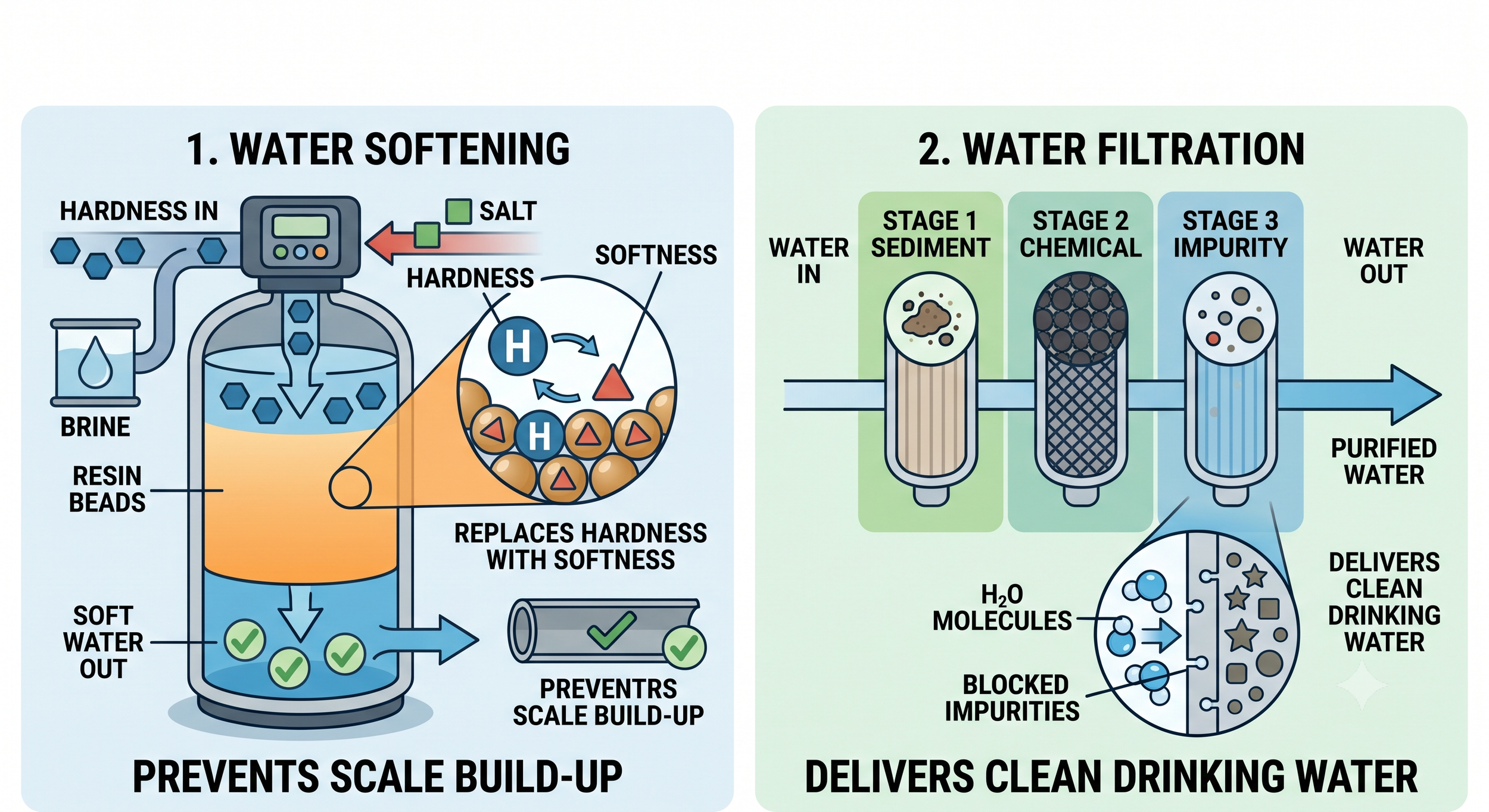
Water Softening (Ion Exchange)
Water softeners target hardness minerals rather than dissolved chemical contaminants:
Resin Bed Trapping: Hard water flows into a resin tank filled with negatively charged resin beads pre-loaded with sodium ions.
Ion Exchange: The strong positive charge of dissolved calcium and magnesium ions causes them to cling to the resin, releasing sodium ions into the water stream in exchange.
Regeneration: Salt (sodium chloride) is used periodically to flush the trapped calcium and magnesium off the resin beads, discharging the minerals down the drain and refreshing the system.
Water Filtration & Purification
Drinking water purification targets fine particulates, chlorine, heavy metals, and organic compounds through physical and chemical separation stages:
Sediment Screening: Physical barriers (sand, sediment mesh, micro-porous cartridges) catch suspended dirt, rust, and pipe debris.
Activated Carbon Adsorption: Granular or block carbon attracts and holds dissolved chemicals, chlorine, VOCs, and foul odor molecules.
Reverse Osmosis (RO): Water is pressurized through a semi-permeable membrane with microscopic pores (~0.0001 microns). Pure water molecules pass through, leaving behind dissolved solids, heavy metals, nitrates, and trace impurities.
3. Solutions for Hard and Impure Water
To address hard water damage alongside taste and purity concerns, WaterSmart provides tailored residential equipment that targets both sides of the problem:
| System Type | Target Issues | Primary Mechanism | Best Used For |
|---|---|---|---|
| Water Softeners | Pipe scale, appliance damage, cloudy dishes, soap inefficiency | Ion exchange resin tank with high-purity salt regeneration | Whole-home infrastructure protection |
| Reverse Osmosis (RO) Purifiers | Dissolved solids, heavy metals, chemical tastes, micro-pollutants | Multi-stage filtration (sediment + carbon + RO membrane) | Point-of-use drinking water & kitchen taps |
| Inline Carbon Filters | Chlorine taste, municipal odours, minor sediment | Activated carbon block media adsorption | Refrigerators, ice makers, and direct faucet lines |
By pairing a whole-house water softener to stop calcium build-up with a high-efficiency drinking water purification system at the kitchen tap, homeowners protect their home infrastructure while enjoying crisp, clean drinking water every day.
Protect Your Home & Enjoy Pure Water Today
Take the first step toward cleaner, safer, and softer tap water.
Contact the team at WaterSmart to book your free water inspection and find the ideal system for your household.
Call 519-886-7331 or request your quote online to start enjoying pure, high-quality drinking water straight from the tap.
“I liked that when I called I was quoted a price straight up, unlike the first two places I called who said someone would have to come to my house give a quote. Greg was friendly, his price reasonable and my water softener was installed three days later. It took less than an hour for the installation. There was no mess, my water is nice & soft (I use test strips), and I’m quite pleased with this company.”