Water Quality Testing in Kitchener-Waterloo: What's Actually in Your Tap Water?

Whether you are making your morning coffee, running a load of laundry, or drawing a glass of water from the tap, your water quality impacts your entire household routine. Because our local municipal supply has a highly unique geological footprint, scheduling professional water quality testing Kitchener or Waterloo services is essential for uncovering exactly what is hidden in your home's pipes.

This comprehensive guide breaks down our regional water profile and details how a targeted evaluation can help you choose the right filtration strategy.

  1. The Unique Reality of Waterloo Region Tap Water

  2. The Big Two Local Water Problems: Hardness & Chlorine

  3. What Does a Local Water Quality Test Measure?

  4. Interpreting Results: Finding Your Perfect System Match

Visit WaterSmart today to get Free Water Quality Testing In-Store!


Key Takeaways

  • Extreme Hardness: Kitchener-Waterloo has some of the hardest municipal water in Canada (20–34+ grains per gallon), requiring dedicated softening to protect plumbing and appliances.

  • Chlorine & Taste: Local tap water is safe but heavily treated with chlorine to maintain disinfection across a massive groundwater pipe network, altering taste and smell.

  • Testing Clarifies Solutions: Comprehensive water quality testing identifies specific issues, showing exactly whether you need a softener, reverse osmosis (RO), or carbon filtration.

  • Actionable Next Step: WaterSmart offers free, comprehensive, in-home water analysis to map your home's treatment path.

1. The Unique Reality of Waterloo Region Tap Water

If you pour a glass of municipal tap water anywhere in the Kitchener-Waterloo region, you are drinking water with a completely different geological history than Toronto or Hamilton.

While those cities draw surface water from Lake Ontario, roughly 80% of our local tap water originates deep underground in pristine, glacial aquifer beds. The remaining 20% is drawn from the Grand River and processed at the advanced Mannheim Water Treatment Plant.

By exploring the exact mineral and chemical composition of this unique municipal supply, you can stop guessing and start taking control of your home’s environmental health. While groundwater is naturally protected from many surface contaminants, its long journey through subterranean limestone, dolomite, and gravel beds leaves behind an incredibly dense mineral footprint.

This makes local tap water structurally unique, safe to drink, but exceptionally taxing on your household plumbing, skin, and appliances. Understanding your water profile through a professional water test in Waterloo or Kitchener is the crucial first step toward protecting your home investments.

 

2. The Big Two Local Water Problems: Hardness & Chlorine

When evaluating local municipal water, homeowners generally face two distinct profiles: heavy mineral scale and aesthetic treatment traits.

Liquid Rock: The Extreme Hardness Profile

Water hardness is defined by the concentration of dissolved calcium and magnesium ions. Across Canada, water measuring over 10.5 grains per gallon (gpg) is classified as "very hard."

In Kitchener-Waterloo, municipal water levels regularly measure between 20 to 34+ grains per gallon. This puts local water off the traditional charts, classifying it as "extremely hard."

This high mineral content causes rapid calcium carbonate precipitation whenever water is heated. The consequences are immediately visible: crusty white buildup on faucets, chalky film on shower glass, spotted dishes, and chronically dry, irritated skin or dull hair.

Behind the scenes, it forms an insulating blanket of stone inside your water heater, drastically dropping its efficiency and shortening its lifespan.

Chemical Disinfection: The Residual Chlorine Issue

Because the Region of Waterloo maintains thousands of kilometers of distribution pipe networks, municipal water treatment facilities must add chlorine to ensure the water remains microbiologically sterile all the way to your tap.

While absolutely vital for public health, residual chlorine leaves a sharp, swimming-pool-like chemical taste and odor in your drinking water, and it can dry out skin and deteriorate rubber seals inside plumbing fixtures over time.

3. What Does a Local Water Quality Test Measure?

A professional, localized water analysis bypasses guesswork. When conducting water quality testing in Kitchener-Waterloo homes, specialists focus heavily on a set of core parameters to pinpoint the precise mineral load and chemical presence in your specific plumbing line.

Water Parameter Typical KW Range What It Means for Your Household
Hardness (Calcium/Magnesium) 20 – 34+ gpg Determines the exact capacity setting and salt consumption curve required for a water softener.
Total Chlorine 0.5 – 2.0 mg/L Indicates the presence of taste/odor causing disinfectants; dictates the need for carbon filtration.
Total Dissolved Solids (TDS) 400 – 700+ ppm Measures the total combined mobile content of all inorganic substances dissolved in the water. High TDS alters drinking flavour.
Iron & Manganese Trace (Municipal) Can cause severe red/brown or black staining on porcelain and laundry, even in minute amounts.
pH Level 7.2 – 7.8 (Balanced) Ensures the water is not acidic, which would cause premature pinhole leaks and copper pipe corrosion.

4. Interpreting Results: Finding Your Perfect System Match

A water quality test provides a clear diagnostic roadmap. The specific numbers on your test report will map directly to one or more specialized water treatment systems.

High Hardness (10+ gpg) -> Ion-Exchange Water Softener

If your test confirms anything above 10 grains of hardness (which is virtually every home in Kitchener-Waterloo), a high-efficiency Water Softener is a baseline necessity. These systems utilize food-grade resin beads coated in sodium ions.

As hard water passes through, the resin acts like a magnet, trapping the heavy calcium and magnesium ions and releasing a microscopic, harmless amount of sodium. This completely eliminates scale buildup, slashes soap usage by up to 50%, and keeps your water heater running at peak efficiency.

High TDS & Chemical Taste -> Reverse Osmosis (RO) System

While a water softener removes the heavy structural minerals, it does not purify your drinking water of dissolved solids, chlorine, or microscopic impurities. If your test demonstrates a high TDS (Total Dissolved Solids) count, a Reverse Osmosis System installed under your kitchen sink is the ultimate remedy. By pushing water through a semi-permeable membrane, it strips away up to 99% of all dissolved substances, providing bottled-quality water straight from a dedicated designer faucet.

High Chlorine Odor -> Whole-Home Carbon Filtration

If you are happy with your drinking water but dislike showering in chlorinated water or noticed your clothes fading quickly in the wash, a Whole-Home Carbon Filter is the answer. Installed at the point where water enters your house, it treats every single drop by absorbing chlorine, volatile organic compounds (VOCs), and general municipal odor before the water flows into your plumbing lines.


Take Control of Your Home's Water Quality Today

Stop guessing what's flowing through your pipes. The team at WaterSmart Systems & Plumbing has been servicing Kitchener, Waterloo, Cambridge, and the surrounding areas since 1994. We understand local groundwater profiles better than anyone else.

Contact us today to book your free, no-obligation, in-home water quality test. Let our local experts test your water parameters right in front of you and recommend the ideal, budget-friendly solution tailored exactly to your household needs.

👉 Book Your Free In-Home Water Test with WaterSmart


Matt was very professional and provided all the options. He was very knowledgeable and did a great job installing our new water softener.
— Kristin VanderVeen
 

Connecting a Water Softener: A Step-by-Step Guide for Homeowner

Hard water isn't just an inconvenience; it’s a silent tax on your home. From the chalky white buildup on your faucets to the "stiff" feeling of your laundry, mineral deposits (calcium and magnesium) gradually degrade your plumbing and appliances. Installing and connecting a water softener is the definitive solution to reclaim your home's efficiency and comfort.

  1. Why Precision Matters in Water Softener Connection

  2. Connecting a Water Softener: Step-by-Step Overview

  3. Common Pitfalls to Avoid

  4. DIY vs. Professional Help

  5. The Benefits of Soft Water

For help installing and connecting a water softener, contact the experts at WaterSmart today.


Key Takeaways

  • Location is Everything: Install the unit at the main water entry point, before the water heater.

  • Safety First: Maintain a 2-inch air gap at the drain to prevent sewage backflow.

  • Protection: Use a bypass valve to preserve softened water during high-volume outdoor tasks.

  • Longevity: Proper calibration based on local water hardness (GPG) prevents salt waste and resin wear.

1. Why Precision Matters in Water Softener Connection

A water softener is more than just a filter; it is a sophisticated ion-exchange system that chemically alters your water chemistry.

Because it integrates directly into your home’s primary plumbing, the quality of the connection dictates the performance and safety of your entire household water supply.

Here’s why precision matters when installing and connecting your water softener.

  • Protecting Water Pressure: A softener must be sized and plumbed to match your home’s flow rate. Using improper pipe diameters or excessive 90-degree fittings creates friction loss. This leads to a noticeable drop in pressure - often felt most during peak usage, such as when running multiple faucets or showers simultaneously.

  • Preventing "Salty Water": The system uses a brine (saltwater) solution to recharge its resin beads. Precise calibration and secure valve connections ensure this salt is thoroughly rinsed away during the final stage of the regeneration cycle. A poor setup or a leak in the brine line can result in residual sodium leaking into your drinking water supply.

  • Eliminating Cross-Contamination: The most critical safety feature is the physical air gap at the drain line. Without a precise 2-inch gap between the softener's discharge hose and the sewer drain, a "cross-connection" is created. If the sewer ever backs up, the resulting siphoning effect could pull bacteria directly into your resin tank, contaminating your home’s potable water supply.

  • Optimizing the Ion-Exchange: If the "In" and "Out" lines are reversed—a common DIY mistake - the water flows backward through the mineral tank. This doesn't just leave you with untreated hard water; the reverse pressure can actually flush the expensive resin beads out of the tank and into your home’s pipes, clogging your faucets, aerators, and high-end appliances.

  • Managing Thermal Stress: If your installation requires soldering copper pipes, precision is required to protect the unit’s internal seals. High-quality installations involve soldering pigtails or using heat-sink cloths to ensure that the heat from the torch never compromises the plastic bypass valves or the integrity of the resin tank.

Click the image below to visit our water softener installation page.


2. Connecting a Water Softener: A Step-by-Step Overview

While every home is unique, a standard installation follows a specific sequence to ensure the system is integrated safely and efficiently.

  1. Locate the Main Water Entry Identify where your main water service enters the home. To be effective, the softener must act as the "gatekeeper" for your plumbing. It should be placed upstream of the water heater to prevent scale buildup in the tank, but downstream of your outdoor hose bibs so you aren't wasting softened water on your lawn.

  2. The Essential Bypass Valve Never skip the bypass valve. This crucial component allows you to divert water around the softener for maintenance or high-volume tasks—like filling a pool or power washing—without exhausting your resin bed or wasting salt.

  3. Mastering Pipe Connections Align the "In" port with your hard water supply and the "Out" port with your home’s treated water line.

    • Pro Tip: If you are soldering copper pipes, complete your welds at least 12 inches away from the unit. The intense heat from a torch can easily warp or melt the plastic bypass valves and internal seals.

  4. Routing Drain and Brine Lines Your system will have two lines: a discharge line for regeneration and an overflow line for the brine tank. Route these to a floor drain or utility sink.

    • Safety Warning: Never seal these lines directly into a drain pipe. A physical air gap is a legal plumbing requirement to prevent sewage from siphoning back into your water supply.

  5. System Activation and Programming Once the plumbing is leak-tested, add high-quality salt pellets to the brine tank. The final step is programming the digital controller. You must input your specific Grains Per Gallon (GPG) hardness level; an incorrect setting will lead to either hard water breakthrough or excessive salt waste.

Pro Tip: The Air Gap Rule

To keep your drinking water safe, never stick your softener's drain hose directly into a pipe. Always leave a 2-inch gap between the hose end and the drain to prevent bacterial backflow.

Contact Us for Expert Installation

3. Common Mistakes to Avoid

Even a small oversight during installation can lead to long-term plumbing headaches. Avoiding these three common pitfalls will ensure your system remains efficient and your home stays protected.

  • Improper Drainage & Code Violations: The most frequent DIY error is hard-piping a drain line directly into a sewer pipe or standpipe. This creates a cross-connection that violates local plumbing codes. Without a visible air gap, there is no way to verify that the system is draining correctly, and you risk a catastrophic bacterial backup.

  • Neglecting Salt Bridges: In high-humidity environments like basements, a hard crust—known as a salt bridge—can form in the brine tank. This creates an empty space between the salt and the water, preventing the brine from forming. If you notice your salt level hasn't dropped in weeks, you likely have a bridge that needs to be manually broken up with a broom handle.

  • Using Under-Sized Fittings: Your water softener should never be a bottleneck. If your home has a 1-inch main water line but you use 1/2-inch or 3/4-inch fittings to connect the softener, you will experience a significant drop in water pressure. Always ensure your connectors match or exceed the diameter of your main service line to maintain a high-performance flow rate.

4. DIY vs. Professional Comparison Chart

Installation Comparison

Feature DIY Installation Professional Install
Warranty Parts Only Full Parts & Labor
Water Testing Basic Test Strip Lab-Grade Analysis
Safety Check Homeowner Assessed Code-Compliant Setup

5. The Benefits of Soft Water

Investing in a water softener provides immediate, tangible improvements to your home’s efficiency and your daily quality of life. By removing the minerals that cause scale and buildup, you transform your home's water from a source of wear-and-tear into a protective asset.

  • Extended Appliance Lifespan: Hard water is the leading cause of premature failure for water heaters, dishwashers, and washing machines. Soft water prevents the internal scale buildup that forces these appliances to work harder and use more energy, potentially extending their lifespan by several years.

  • Significant Cost Savings: Because soft water allows soaps and detergents to lather more effectively, you can reduce your cleaning product consumption by up to 30% to 50%. You will also see lower energy bills as your water heater remains free of insulating mineral deposits.

  • Brighter Laundry & Softer Linens: Mineral deposits trap dirt and soap scum in fabric fibers, making clothes feel stiff and colors look dull. Soft water rinses completely clean, keeping your towels fluffy and your whites brighter for longer.

  • Healthier Skin and Hair: Hard water strips natural oils from your body, often leading to dry, itchy skin and brittle hair. Soft water maintains your body’s natural moisture balance, resulting in a noticeable difference in how you feel after every shower.

  • Effortless Cleaning: Say goodbye to the stubborn "white film" on glass shower doors and chalky spots on your dishes. Soft water eliminates the mineral residue that makes housework feel like an endless battle.


Ready to Upgrade Your Home’s Water?

Understanding the process is the first step; getting it right is the next.

Whether you have questions about your home’s specific plumbing or you’re ready to schedule a professional installation, our team is here to help.

Contact Water Smart Systems today to ensure your new system is installed with the precision and expertise your home deserves.


Service people are great but I’ve had to have the softener repaired twice in less than a month for the same problem
— John Tummon
 

The Ultimate Guide to a Whole House Water Filter System in Ontario (2026)

Clean water is the foundation of a healthy home. In Ontario, our water quality is as diverse as our landscape - ranging from the hard, mineral-heavy aquifer water in the Waterloo Region to the complex chemical profiles of municipal systems in the GTA and the bacterial risks inherent in rural well water.

This guide breaks down everything you need to know to secure high-quality water for your family, whether you're in a downtown condo or a rural farmhouse.

  1. Common Water Contaminants in Ontario

  2. Types of Whole House Water Filter Systems

  3. Filtration vs. Softening: The Comparison

  4. 2026 Maintenance & Cost Breakdown

  5. Ontario Buyer’s Checklist

  6. Frequently Asked Questions (FAQs)

Stop guessing and start knowing. WaterSmart technicians provide detailed onsite testing and custom system design for homes across Kitchener, Waterloo, Guelph, and Cambridge. Contact us today!


Key Takeaways

  • Source Matters: City water users primarily need to target chlorine, lead, and disinfection byproducts, while well owners must prioritize bacteria, nitrates, and heavy metals.

  • Filtration Isn’t Softening: Filtration removes contaminants (chemicals/pathogens); softening removes minerals (calcium/magnesium). Most Ontario homes benefit from a "stacked" approach.

  • Maintenance is Non-Negotiable: A neglected filter can become a breeding ground for bacteria. Budget roughly $150–$500 annually for professional upkeep and media replacement.

  • Verify Certifications: Ensure any system carries NSF/ANSI certifications (Standard 42 for aesthetics, 53 for health effects) to guarantee performance.

1. Common Water Contaminants in Ontario

Ontario’s geography and aging infrastructure present unique challenges. Residents typically face different issues depending on their source:

City Water (Municipal)

Most municipal systems use chlorine or chloramines for disinfection. While safe, these leave an unpleasant swimming pool taste.

  • Disinfection Byproducts (THMs/HAAs): These form when chlorine reacts with organic matter. Levels can be higher for homes at the end of long distribution lines.

  • Lead: Highly localized. Older homes in Kitchener or Guelph (built before the mid-1950s) may have lead service lines or lead solder that leaches into the water, even if the city plant tests clean.

  • Emerging Contaminants: PFAS ("forever chemicals") and microplastics are increasingly being monitored by provincial authorities in 2026.

Well Water (Private)

Ontario does not regulate private well quality; the homeowner is the utility manager.

  • Bacteria: E. coli and total coliforms can enter through surface runoff or compromised well casings.

  • Nitrates: Common in agricultural areas like Wilmot or Woolwich due to fertilizer runoff. These are particularly dangerous for infants.

  • Naturally Occurring Minerals: Arsenic, uranium, and fluoride are found in specific geological formations across the province and require specialized chemical testing to detect.


2. Types of Whole House Water Filter Systems

A "whole house" or Point-of-Entry (POE) system treats water at the main line before it reaches any tap.

1. Carbon Filtration (Chemical Removal)

Activated carbon is the primary defense against taste and odor issues. It uses adsorption to "trap" chemicals.

  • Best For: Chlorine, chloramines, pesticides, and VOCs. \

  • Ontario Use Case: Ideal for city dwellers who want "bottled water quality" from every tap.

2. Sediment Filters (Physical Barrier)

These act as a fine mesh to catch physical debris. In 2026, multi-gradient "spin-down" filters are popular for high-turbidity areas.

  • Best For: Dirt, sand, silt, and rust flakes.

  • Ontario Use Case: Essential as a "pre-filter" for well water to protect downstream equipment like UV lights and softeners.

3. Ultraviolet (UV) Purification (Disinfection)

UV systems use high-intensity light to scramble the DNA of microorganisms, making them unable to replicate.

  • Best For: Neutralizing 99.9% of bacteria and viruses without chemicals.

  • Ontario Use Case: A legal or safety requirement for many rural properties and cottages.

4. Reverse Osmosis (RO) (Total Purity)

RO pushes water through a semi-permeable membrane. While often "point-of-use" (under-sink), whole-house RO is used when TDS (Total Dissolved Solids) levels are extremely high.

  • Best For: Lead, arsenic, fluoride, and nitrates.

  • Ontario Use Case: Recommended for wells with high mineral salt or heavy metal content.

3. Filtration vs. Softening: What’s the Difference?

In hard water regions like Cambridge and Waterloo, using both is often a necessity, not a luxury.

Feature Water Softener Water Filter
Primary Goal Removes hardness minerals (Calcium & Magnesium) Removes harmful contaminants (Chlorine, Lead, Bacteria)
Main Benefit Prevents scale buildup; protects pipes and appliances Provides safer, better-tasting drinking and bathing water
Technology Ion exchange (typically salt-based) Physical/Chemical media (Carbon, UV, or Reverse Osmosis)
Maintenance Monthly salt refills and annual resin cleaning Periodic cartridge or UV lamp replacement
Ontario Use Case Essential for "Hard Water" regions like Waterloo & Guelph Necessary for chemical/bacteria removal (City or Well)

4. 2026 Maintenance & Cost Breakdown

Investing in a whole house water filter system involves both the initial Point-of-Entry (POE) setup and the recurring costs required to keep the water safe.

In Ontario, costs are influenced by the complexity of the stack - for instance, a home on a well requiring UV and Iron filtration will face higher upfront and maintenance costs than a city home needing only carbon filtration.

Initial Investment: Buying vs. Renting

  • Whole House Purchase ($1,500 – $10,000):

    • Basic Carbon/Sediment: $1,500 – $2,500.

    • Advanced Multi-Stage (UV + Softener + Carbon): $4,000 – $8,000.

    • Whole-House Reverse Osmosis: $8,000 – $10,000+ (typically reserved for extreme cases like high sodium or fluoride).

  • Monthly Rentals ($29.99 – $49.99/month): This is a popular Ontario model (e.g., through WaterSmart or Reliance) that eliminates upfront capital. It typically includes free standard installation and covers all future repairs, parts, and labor.

Ongoing Consumable Costs

To maintain high authority and water safety, components must be replaced on a strict schedule:

  • UV Lamps ($100 – $250): These must be replaced annually. Even if the light is still visible, the germicidal intensity fades after ~9,000 hours of use, leaving your water vulnerable to bacteria.

  • Filter Cartridges ($50 – $150):

    • Sediment Pre-filters: Replace every 3–6 months to prevent pressure drops.

    • Carbon Blocks: Replace every 6–12 months to ensure effective chlorine and VOC removal.

  • Professional Inspection ($150 – $300): An annual service call is recommended to sanitize the system, check O-rings/valves for leaks, and verify the flow rate is still meeting your household's demand.


5. Ontario Buyer’s Checklist

Before signing a contract, ensure your system is properly sized and targeted for local conditions.

1. Test Your Specific Water

  • Well Owners: Use Public Health Ontario for free bacterial testing (E. coli and Coliforms). However, you must hire a private lab (approx. $200–$400) for "health-based" chemical testing like Arsenic, Lead, and Nitrates, which the provincial test does not cover.

  • City Residents: Focus on a "Total Dissolved Solids" (TDS) and Chlorine test to see if your local municipal aging infrastructure is impacting your home.

2. Calculate Required Flow Rate (GPM)

  • A system with a low Gallons Per Minute (GPM) rating will cause frustrating pressure drops when two showers run at once.

  • Average Home (3-5 people): Aim for 8–12 GPM.

  • Large Household (6+ people): Aim for 15+ GPM.

3. Insist on a Bypass Valve

Ensure your plumber installs a manual bypass. This allows you to use untreated water for outdoor tasks like filling a pool or watering the lawn, extending the life of your expensive filter media.

4. Local Expertise Matters

Ontario water isn't a monolith. A system designed for the softer water in parts of the GTA will fail quickly against the 30+ grains of hardness found in Guelph or Kitchener. Choose a provider that benchmarks their equipment against local municipal water reports.

6. Frequently Asked Questions (FAQs)

Q: Does a whole house water filter system remove hardness scale?

A: Generally, no. Standard whole house filters (carbon, sediment, or UV) target chemicals and pathogens. To remove the calcium and magnesium that cause white scale buildup on faucets and damage appliances, you need a water softener. Many Ontario homeowners "stack" a carbon filter on top of a softener for the best results.

Q: How often should I test my well water?

A: Public Health Ontario recommends testing for bacteria at least three times per year. The best times are during seasonal shifts:

  1. Spring: After the snowmelt when runoff is highest.

  2. Summer: During peak usage or after a major "1-in-100-year" rain event.

  3. Fall: Before the ground freezes. Note: A full chemical analysis (for Lead, Arsenic, and Nitrates) should be done every 2–5 years.

Q: Will a whole house filter affect my water pressure?

A: If sized correctly, the impact is negligible (usually less than a 3–5 PSI drop). However, if you fail to change your sediment filter, it will eventually clog, leading to a significant loss of pressure throughout the home.

Helpful Links & Resources


Get a Professional Water Quality Assessment

Protect your home’s plumbing and your family’s health with a solution tailored to Ontario's unique water challenges.

Request your Water Quality Assessment today to find the perfect filtration or water softener solution for your home.


Efficient assessment and repair of my water softener. I love the text notification system. Very happy with this experience!
— Karen Derrah
 

Soft Water Conditioners vs Traditional Softeners - What’s Best?

If you are dealing with white crusty buildup on your faucets or dry, itchy skin after a shower, you’ve likely looked into water treatment. However, the search for a solution often leads to a confusing debate: Soft water conditioners vs. water softeners.

While the terms are often used interchangeably by marketers, they represent two completely different technologies. This guide will break down the differences in effectiveness, cost, and maintenance to help you decide which is right for your home.

  1. Soft Water Conditioners vs Traditional Softeners: Defining the Systems

  2. Side-by-Side Comparison

  3. Detailed Analysis: Effectiveness & Maintenance

  4. Myths and Misconceptions

  5. Decision Guide: Which Should You Choose?

The experts at WaterSmart can help you figure out what’s best for your household. Contact us today.


Key Takeaways

  • Water Softeners: The only systems that physically remove hardness minerals. Best for a luxury feel and preventing soap scum.

  • Water Conditioners: These are descalers. They keep minerals in the water but prevent them from sticking to pipes. Best for low-maintenance "green" homes.

  • Maintenance: Softeners require salt refills; Conditioners are generally "set it and forget it" for 1–3 years at a time.

1. Soft Water Conditioners vs Traditional Softeners: Defining the Systems

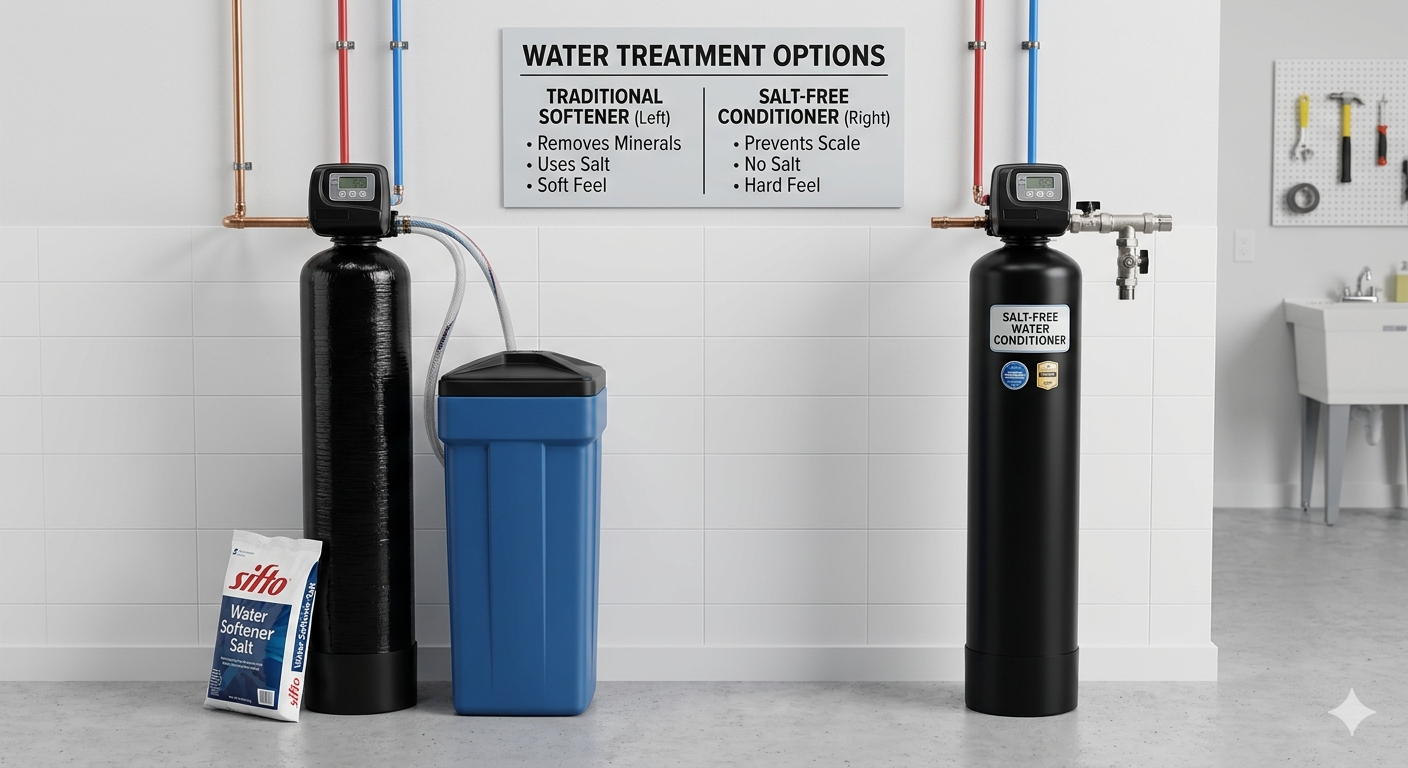
Traditional Water Softener (Ion Exchange)

A water softener is a chemical, physical-exchange plant for your home. Inside the tank are millions of microscopic resin beads charged with sodium ions.

As hard water (rich in Calcium and Magnesium) flows through, the beads act like a magnet, grabbing the hardness minerals and releasing a tiny amount of sodium in their place.

When the beads are "full" of minerals, the system enters a regeneration cycle, flushing the minerals away with a brine solution and recharging the beads.

Soft Water Conditioner (Physical Water Treatment)

Conditioners do not use chemicals or salt to remove minerals. Instead, they use Template Assisted Crystallization (TAC).

As water passes through the conditioning media, the hardness minerals are converted into microscopic seed crystals. These crystals remain suspended in the water but lose their ability to stick to surfaces. They simply flow through your plumbing and down the drain without creating scale.


2. Side-by-Side Comparison

Feature Water Softener Water Conditioner
Mineral Removal 100% Removal 0% Removal (Neutralizes)
Scale Prevention Excellent (Removes cause) Good (Prevents sticking)
Salt Usage Required (Monthly) None
Maintenance Moderate (Adding salt) Low (Annual check)
Water Feel Slippery / "Clean" Standard hard water feel
Soap Lather High (Uses 50% less) Standard (No change)
Eco-Impact Salt discharge (Brine) Eco-friendly (No waste)

3. Detailed Analysis: Effectiveness & Maintenance

Plumbing & Appliance Protection

The "best" system often depends on what you are trying to save.

  • For the Water Heater: Both systems are excellent. Scale is the #1 killer of water heaters, and both technologies prevent that rock buildup on heating elements, maintaining your energy efficiency.

  • For Surfaces and Fixtures: This is where the softener wins. Because a softener removes the minerals, you won't see white spots on your glass shower doors or film on your silverware. A conditioner prevents scale inside the pipes, but because the minerals are still present, you will still see spotting on surfaces where water is allowed to air-dry.

Maintenance and Longevity

  • Softener: Requires a hands-on approach. You must monitor salt levels and physically lift and pour 40lb bags of salt into the brine tank every few weeks.

  • Conditioner: Truly a "set it and forget it" system. There are no salt bags to buy, no wastewater produced, and no electricity required. Most media only needs to be replaced every 3 to 5 years.


4. Myths and Misconceptions

Myth: "Salt-free softeners" are just as good for laundry.

  • The Reality: Not quite. To get truly bright whites and use less detergent, the minerals must be removed. A conditioner helps your washing machine last longer, but it won't help your detergent suds up better or prevent "dingy" whites.

Myth: Water softeners make your water "salty."

  • The Reality: The amount of sodium added to a gallon of soft water is roughly equivalent to the sodium in a single slice of bread. It is not "salty" to the taste, though many homeowners choose to pair their softener with a Reverse Osmosis system for purified drinking water.

Myth: Removing minerals from water makes it "less healthy" to drink.

  • The Reality: While calcium and magnesium are essential nutrients, the amounts found in hard tap water are statistically insignificant compared to your diet. You would have to drink gallons of hard water to get the same amount of calcium found in a single glass of milk. Water treatment is about protecting your home and skin; you should look to food, not your pipes, for your daily mineral intake.

5. Decision Guide: Which Should You Choose?

Choose a Traditional Water Softener if:

  • You are tired of scrubbing soap scum and "ring around the tub."

  • You have eczema or dry skin issues that are aggravated by hard water minerals.

  • You want your towels and clothes to feel soft, not "crunchy."

  • You want the absolute best protection for every water-using appliance in the house.

Choose a Water Conditioner if:

  • You live in a "Salt-Restricted" zone where traditional softeners are banned.

  • You don't want the physical hassle of carrying heavy salt bags.

  • You are primarily focused on protecting the lifespan of your pipes and tankless water heater.

  • You prefer the taste of mineral-rich water but want to avoid the internal scale.


Determine the Best Solution with WaterSmart

Choosing between a conditioner and a softener isn't just about preference—it's about your home's specific water chemistry and your local environment.

At WaterSmart, we don't believe in one-size-fits-all. We provide professional water testing and honest, expert advice to ensure you get the system that fits your lifestyle and your budget.

Stop guessing and start enjoying better water. Contact WaterSmart today for a free consultation and water test!


Fantastic service!! Water softener fixed and we are good to go for a few more years. Greg and Scott were fantastic to deal with!
— Katie Cassidy
 

Watersmart’s Top Picks for Water Softeners for Entire Houses in Waterloo Region

Living in the Waterloo Region means dealing with some of the hardest water in Canada. Whether you are in Kitchener, Waterloo, Cambridge, or the surrounding townships, the "rock" in your water isn't just an annoyance—it’s a constant tax on your plumbing, appliances, and skin.

At WaterSmart Systems, we’ve spent decades installing and servicing water softeners across Southern Ontario. We know exactly what it takes to protect a home from the local groundwater profile. If you are looking for a water softener for your entire house in the Waterloo Region, here is everything you need to know to make an informed choice.

  1. Why Waterloo Region Water is Unique

  2. Common Issues Waterloo Homeowners Face

  3. Top 3 Recommended Systems for the Region

  4. Should You Consider Other Brands?

  5. FAQs for Waterloo Homeowners

Don't let hard water damage your home any longer. Positioned right here in Waterloo, WaterSmart Systems is your local partner for all things water. Contact or visit us today!


Key Takeaways

  • Extreme Hardness: Local water contains 17–38 grains of hardness per gallon, among the highest in Canada.

  • System Choice Matters: In this region, a "budget" softener from a big-box store often fails within 5 years due to the heavy mineral load.

  • Local Advantage: Systems with look-ahead technology save significant money on salt and water by adapting to Waterloo’s specific groundwater profiles.

  • Professional Care: Licensed installation ensures your system is calibrated for your specific street's hardness levels, preventing scale and protecting warranties.

1. Why Waterloo Region Water is Unique

Most of our drinking water comes from groundwater wells. As water travels through underground aquifers, it picks up heavy amounts of calcium and magnesium from the local limestone.

While hard water is technically anything over 7 grains per gallon (gpg), Waterloo Region typically sees levels ranging from 17 to 38 gpg.

Municipal vs. Well Water

  • Municipal Users: Even city water in Kitchener or Waterloo is incredibly hard. You also have to contend with chlorine used for disinfection, which can prematurely wear down the resin beads inside cheaper softeners.

  • Well Water Users: If you are on a private well in Wilmot or Woolwich, you may also face issues with iron (orange staining) and sediment, requiring a system with higher clear water iron removal capabilities.

In short, a water softener in any Waterloo Region home is a must.

2. Common Issues Waterloo Homeowners Face

Without a high-efficiency whole-home water softener system, you’ll likely notice:

  1. Scale Build-up: White crust on faucets and showerheads.

  2. Appliance Failure: Dishwashers and water heaters failing years before they should.

  3. Dry Skin & Hair: Hard water prevents soap from lathering and leaves a film on your body.

  4. High Energy Bills: Your water heater has to work twice as hard to heat through layers of scale.

For a more detailed breakdown, read Plumbing in Kitchener: Dealing with Hard Water.

2. Top 3 Recommended Systems for Waterloo Region

We’ve selected these models based on their reliability in handling high grain counts and their salt efficiency.

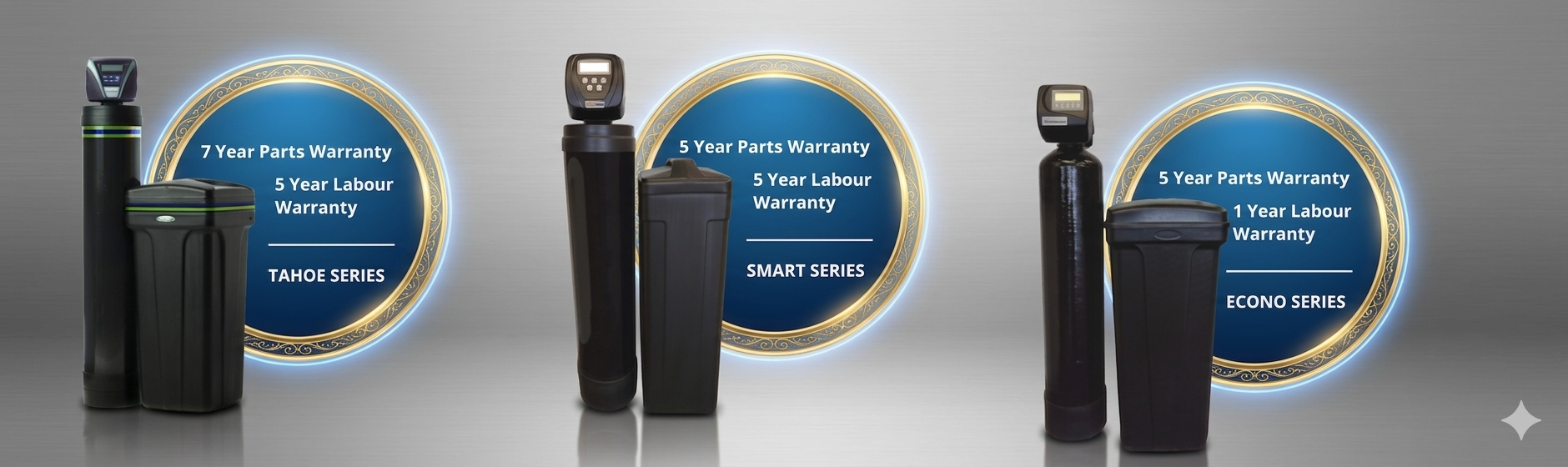
1. The Smart Series by WaterSmart

This is our "gold standard" for the local area. It features a "look ahead" computer that tracks your water usage patterns to ensure it only regenerates when absolutely necessary.

  • Best For: Active families in Kitchener/Waterloo with high water demand.

  • Key Benefit: Maximize salt and water savings while ensuring you never run out of soft water.

2. The Tahoe Series

A rugged, heavy-duty workhorse designed for longevity and high flow rates.

  • Best For: Larger homes with multiple bathrooms or households with higher-than-average water pressure.

  • Key Benefit: High service flow (up to 27 GPM) means no drop in water pressure when the shower and laundry are running simultaneously.

3. The Econo Series

Reliable, simple, and effective. It uses a solid-state programmable computer to regenerate on demand.

  • Best For: Budget-conscious homeowners or smaller households (1-3 people).

  • Key Benefit: Affordable entry point into high-quality soft water without sacrificing local durability.

4. Should You Consider Other Brands?

Many homeowners ask about major brands like Fleck, GE, or Whirlpool. While these are reputable names globally, they often require specific considerations for the Waterloo Region:

  • Fleck Valves: We often service Fleck systems because they are modular and reliable. However, they must be paired with high-quality 10% cross-linked resin to survive the high chlorine and mineral levels found in Southern Ontario.

  • Big-Box Brands (GE/Whirlpool): These are often "cabinet-style" units. While affordable upfront, they frequently struggle with the 30+ grain hardness found in areas like Elmira or North Waterloo, leading to frequent breakdowns.

WaterSmart’s Advantage: We specialize in the repair and service of almost all brands (excluding Kinetico and Culligan due to parts restrictions). This give us a unique perspective: we know which brands break down and why, and we design our house-brand systems to avoid those exact pitfalls.

5. FAQs for Waterloo Homeowners

Q: What should I set my water softener hardness to in Waterloo?

A: Depending on your specific neighborhood, you should usually set it between 25 and 35. We recommend a free water test to get the exact number for your street.

Q: Does a water softener remove chlorine?

A: Standard softeners do not, but we can install a carbon filter or a Reverse Osmosis system in tandem to ensure your drinking water is both soft and chemical-free.

Q: Can I install it myself?

A: While possible, Waterloo plumbing can be tricky. WaterSmart provides free basic installation with every purchase, handled by licensed plumbers who understand local building codes.


Get Hard Water Help Today

Ready to stop the scale and start enjoying truly soft water? Whether you need a brand-new installation for your home or a quick repair on your existing unit, the local experts at WaterSmart Systems are here to help.

3 Ways to Get Started:

  • Schedule a Free Water Test: Find out exactly how many grains of hardness are in your water so we can calibrate your system perfectly.

  • Request a Fast Quote: Tell us about your home size and needs, and we’ll provide a transparent, no-obligation estimate.

  • Visit Our Showroom: See the Smart, Tahoe, and Econo series in person and chat with our friendly staff.

Don't let hard water win. Protect your home and your skin with Waterloo’s most trusted water experts.


From start to finish: easy to call, get necessary answers and arrange service. Service prompt, polite and efficient. No hassles.
— Ingrid Hahn
Powered By ProfitWorks.ca
" "